New Patients
(941) 203-4247
Current Patients
(941) 922-0671


At Munton Dental Studio, your comfort and well-being guide everything we do. Our skilled, experienced team works to make each visit calm and as stress-free as possible. Patients trust us because we offer caring, personal attention and gentle, precise treatment every time.
Saving your natural teeth is always our first goal. We look at options such as fillings, crowns, and root canals whenever they make sense. Still, removing a tooth is sometimes the best way to protect your oral health and your overall health.
A baby (deciduous) tooth that won't fall out, or one that is badly decayed or damaged
Most baby teeth loosen and fall out on schedule as the permanent tooth underneath starts to come in. Now and then, though, a baby tooth stays firmly anchored in the bone. This happens when its roots don't shrink away (resorb) as they should, or when the tooth becomes ankylosed, meaning it fuses to the bone around it. A baby tooth that stays too long can interfere with how your child's smile grows and lines up. We keep an eye on your child's development at each visit and will let you know if a baby tooth needs to come out so the permanent tooth can erupt.
A permanent tooth with decay too extensive to repair
Tooth decay starts as a tiny spot in the outer enamel. Left alone, it keeps spreading inward and destroying healthy tooth structure. Over time, a cavity can cause major structural damage, permanently harm the tooth's nerve, lead to infection, and create serious problems for your mouth and your general health. If too much of the tooth has been lost to restore it, extraction may be the right choice.
A permanent tooth with a severe crack or fracture that can't be restored
Teeth can chip, crack, and break in many different ways. How much damage occurs decides whether enough healthy structure remains to save the tooth, and which treatment fits best. When too much of the tooth is lost, or the crack reaches the root, removal may be needed.
Advanced gum disease that has badly weakened the tooth's support
Gum disease is the leading cause of tooth loss in adults. Periodontal disease attacks both the gums and the bone that hold your teeth in place. Without treatment, it can create deep gum pockets, cause the gums to recede, and wear away the alveolar bone. As the disease advances, teeth eventually loosen, fall out, or have to be extracted. Learn more about periodontal treatment.
Wisdom teeth that are poorly positioned, impacted, or decayed
Wisdom teeth, or third molars, are the last permanent teeth to form and the last to come in. Very often they lack the space to erupt, develop in the wrong position, decay heavily, or cause trouble for nearby teeth and tissues. Older patients sometimes need wisdom teeth removed, but it is more common to take out problem or likely-problem third molars early, in young adulthood.
Overcrowded teeth
When the teeth are too large for the jaws, the result is often a crowded, crooked smile. Put simply, there isn't enough room in the upper and lower jaws for every permanent tooth. To create a healthy, functional, attractive bite, an orthodontic treatment plan may call for removing certain permanent teeth.

No matter why you need a tooth removed, you can count on careful, attentive treatment at our Sarasota office. We start by going over your medical and dental history with you and talking through anything that may affect your care.
Please tell us about any health conditions you have and every medication you take. Some patients need extra precautions, such as taking antibiotics beforehand, adjusting a medication, or getting clearance from their physician. Follow the pre-surgery instructions we give you, and call us if you feel sick or notice new symptoms on the day of your procedure.
We want you to feel relaxed and comfortable whenever an extraction is needed. Before treatment, we review any medical concerns and walk you through our pre-surgery instructions. We also explain what to expect afterward, including whether the tooth should be replaced and which options suit you best.
To understand the tooth fully and plan the right type of extraction, we complete a thorough exam and take digital radiographs when needed. Most extractions fall into one of two groups: simple or surgical.
A simple extraction is usually used when the tooth is fully visible in the mouth and its roots are not sharply curved, fused to the bone, or shaped in an unusual way. After we numb the tooth and surrounding area with a local anesthetic, our dentist gently frees the gum tissue attached to the tooth and lifts it out with forceps. Your comfort matters at every step. If dental work makes you nervous, ask us about dental sedation.
Teeth that are badly broken down, ankylosed, or impacted often call for a surgical extraction. In these cases, we may refer you to an oral and maxillofacial surgeon. The procedure involves a small opening in the gum and careful removal of a little bone over the tooth so it can be reached and taken out. As with every extraction, a local anesthetic fully numbs the tooth and the tissues around it. We also review dental sedation options, pre-surgery considerations, and instructions in detail so you know exactly what to expect.
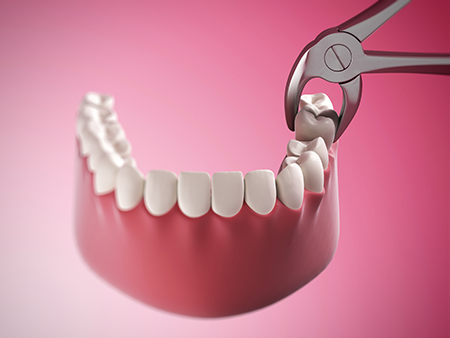
Every patient is different, so we tailor your care to your needs. Based on your situation, we give you aftercare instructions that may cover special precautions, activity limits, medications, and follow-up visits, all aimed at helping you heal well. Sometimes your physician may also be part of your recovery plan. Unless we tell you otherwise, the guidelines below apply after a simple extraction.
Keep pressure on the gauze
We'll place gauze over the extraction site before you leave. Bite down firmly on it as directed to stop active bleeding. You can replace the gauze after the first hour. If heavy oozing continues, bite down for another 45 minutes. Light oozing for up to 24 hours is normal, but call our office if bleeding or oozing stays heavy.
While you are still numb
Until the local anesthetic wears off completely, take care not to bite or hurt your lips, cheeks, gums, or tongue by accident.
Take medications as prescribed
Antibiotics:
If we prescribe antibiotics, take the exact dose and finish the entire course.
Pain management:
Taking a pain reliever before the numbness fades can help. Over-the-counter pain medicine that does not contain aspirin can ease discomfort. Take any prescription pain medicine only as directed.
Protect the healing site
Don't rinse, spit, drink through a straw, or suck on candy. A blood clot needs to form in the socket, and it must stay in place once it does.
Use ice
Hold an ice pack on your face over the extraction area to keep swelling down. On the first day, apply it in 10-minute intervals.
Skip smoking
Smoking keeps a clot from forming and slows healing. Avoid smoking and all tobacco products for the first week.
Choose foods and drinks with care
For the first day or two, avoid hot or spicy foods and drinks, and don't have carbonated or alcoholic beverages. Eat soft foods and liquids for the first couple of days after surgery, and drink plenty of fluids.
Keep your mouth clean gently
Brush softly, and be careful not to bother or irritate the extraction site for a few days. A very mild, lukewarm saltwater solution can help your mouth feel fresh. For the first day or two, don't rinse or spit. Just lean over the sink and let liquid flow out of your mouth.
Keep your follow-up appointment
If you received sutures (stitches), or if a complex extraction, an infection, or another issue means we need to check your healing, we'll schedule a follow-up visit. Please be sure to keep it.
Call our office if bleeding continues, pain doesn't let up, swelling increases, you notice a bad taste in your mouth, or anything else seems unusual. You can also reach us through our contact page.
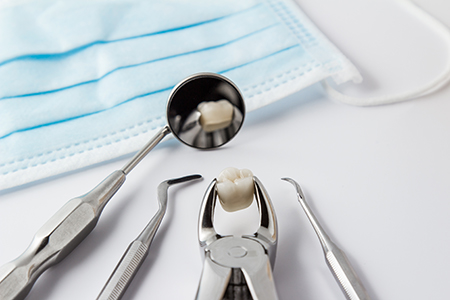
You deserve dental care built around you, and at Munton Dental Studio your smile is in caring, capable hands. Our treatment is gentle and precise, and we keep you informed and at ease from start to finish. If a missing tooth should be replaced, we'll review your options with you, including dentures, fixed bridges, and dental implants. Dental implants are the most advanced way to replace teeth, and they come closest to matching the look, feel, and function of natural teeth. For patients replacing many teeth, we can also talk about All-on-4® treatment.
Ready to talk about an extraction in Sarasota? Request an appointment with our team today.
Before any extraction, a local anesthetic fully numbs the tooth and the tissues around it, so you should feel pressure rather than sharp pain during the procedure. If dental visits make you anxious, ask our team about dental sedation options.
Some soreness is normal once the numbness wears off. Taking a non-aspirin pain reliever before the anesthetic fades can help, and any prescription pain medicine should be taken only as directed.
Healing time varies from person to person and depends on whether you had a simple or surgical extraction. Light oozing for up to 24 hours is normal, and most of the care guidelines focus on the first few days, such as eating soft foods and protecting the blood clot.
Avoiding smoking and tobacco for the first week helps the site heal. If you have stitches or a more complex extraction, a follow-up visit lets our team check how you are healing.
For the first couple of days, stick to soft foods and liquids, and drink plenty of fluids. Good choices are foods that need little chewing and are not too hot.
For the first day or two, avoid hot or spicy foods and drinks, as well as carbonated and alcoholic beverages. Skip straws and sucking on candy, since suction can disturb the blood clot that needs to stay in the socket.
It depends on which tooth was removed and why. Baby teeth or teeth removed for orthodontic reasons usually do not need replacing, while a missing permanent tooth often does to keep your bite healthy and functional.
At Munton Dental Studio, we review replacement options with you before treatment, including dentures, fixed bridges, and dental implants, so you can choose what suits your needs best.
Several factors can influence cost, including:
Our team will explain your treatment plan during your exam so you understand what to expect before your procedure.